






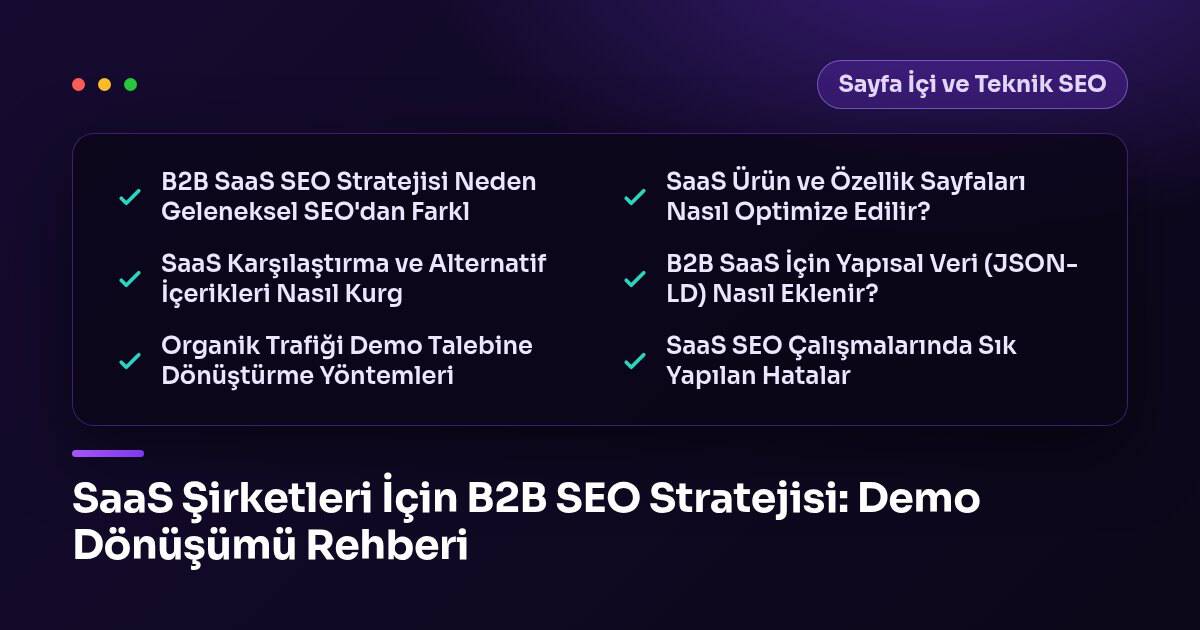
SaaS SEO, is a conversion-focused method that enables software companies to reach potential B2B customers on search engines to generate direct demo requests and sign-ups. The organic traffic needed for a software firm's growth is not just about increasing visitor numbers, but about reaching professionals who make the right decisions. This approach develops strategies that focus on how the product solves specific problems rather than general content.
Why is B2B SaaS SEO Different from Traditional SEO?
In the B2B SaaS model, the target audience consists of business executives who make decisions based on technical needs and efficiency, not emotional impulses. While traditional content-focused SEO approaches appeal to a general audience, in the SaaS world, every page is a potential sales opportunity. For a software firm, success is convincing the person coming from a search engine that they can use the product as a tool.
| Feature | B2C SEO | B2B SaaS SEO |
|---|---|---|
| Target group | Individual users | Business decision-makers |
| Sales Cycle | Short and direct | Long and multi-stage |
| Success Criteria | Traffic volume | Demo and sign-up conversion |
The sales cycle in the SaaS world is complex because the person making the purchasing decision may not be the person using the product. For example, for HR software, the HR manager does the research, but the person approving the budget is the finance manager. Therefore, the content structure must meet the needs of these two different profiles simultaneously. If you are looking for strategic support for corporate growth, corporate SEO service you can review our pages to create a customized roadmap for your business.
How to Optimize SaaS Product and Feature Pages?
Product and feature pages are the conversion engines of your SaaS site and must be optimized so that search engines understand these pages correctly. A feature page should not be structured like a technical document, but as a solution guide that explains which business problem it solves and how.
- The target audience and the solution should be presented together in the page title.
- Instead of a list of features, paragraphs explaining the tangible benefit the feature brings should be written.
- At least two clear and actionable call-to-action (CTA) buttons should be used on the page.
- Daily business language used by users should be preferred over technical terminology.
- Page speed and mobile compatibility are priorities for professionals looking for software.
Keeping a checklist for each feature page speeds up the process. For example, headlines like "Reduce reporting time by 40% with our X feature" are very effective in persuading the user. There should always be a demo request form or button at the top of the page or near the "services" section.
How to Structure SaaS Comparison and Alternative Content?
Comparison and alternative content are decision-making stops for users in the purchasing stage and directly increase demo conversions. When a user searches for whether there is an alternative to the software they are using, presenting a page that compares your own product with your competitor is the most effective method. Such content is designed to clear up the user's questions and explain on a rational basis why they should prefer your solution.
For example, a CRM software developer can attract traffic to their own page by creating titles like "X CRM Alternatives" or "X vs Y CRM." In this content, instead of badmouthing the competitor, you should explain with a clear table at which point your product offers a better solution.
| Content Type | Search Intent | Purpose |
|---|---|---|
| X vs Y | To compare | Highlighting the differences |
| X Alternative | Search | Showcasing innovations |
| X Review | Evaluation | Highlighting advantages |
When structuring such content, search intent guide following these principles allows you to understand what the user is actually looking for. By analyzing whether the user simply wants a name comparison or is curious about a technical feature difference, you can shape your content accordingly.
How to Add Structured Data (JSON-LD) for B2B SaaS?
Using structured data to clearly inform search engines about your product, pricing, and software type is a critical step for technical SEO. Properly implemented schema data allows information like your product's star rating or price to appear in search results, which increases click-through rates.
<script type="application/ld+json">{ "@context": "https://schema.org", "@type": "SoftwareApplication", "name": "SaaS CRM Platformu", "operatingSystem": "All", "applicationCategory": "BusinessApplication", "offers": { "@type": "Offer", "price": "0", "priceCurrency": "USD" } }</script>The "@type" expression in this code block informs Google that the content is a software application. The "applicationCategory" part defines which industry the software serves. The "offers" section defines the product's commercial models, such as a demo or free trial, to the search engine. This code snippet should be added between the "head" tags in your site's source code.
Methods to Convert Organic Traffic into Demo Requests
Converting organic traffic into demo requests is possible by capturing the user at the right stage with the right content. When people come to your site looking for information, you should suggest a demo as the next step. You can implement the following methods to increase your conversion rate:
- Contextual CTA Placement: Add text-based and persuasive links such as "Overcome this problem with our solution" right below the sections in your blog posts where your product is mentioned.
- Using Content Magnets: Users may not be ready for a demo yet. At this stage, offer them an e-book or guide related to the industry to capture their email addresses, then guide them to a demo via an email sequence.
- Landing Page Optimization: Remove unnecessary navigation elements from the landing pages where you drive traffic. Ensure your form is simple and only asks for essential information.
- Heatmap Analysis: Use tools that analyze visitor behavior on your site. Find out at which point users give up before filling out the form and improve that section.
- Displaying Social Proof: Build trust by adding logos or short success testimonials from similar-scale businesses you work with, right next to or below the demo form.
First, Keyword Analysis use our tool to determine which terms your potential customers are using to search for products. Create landing pages targeting high-conversion keywords with the data you obtain. If a visitor comes from a blog post, direct them to the product page with a "Get a Free Demo" button in the middle of the post. When you offer the user a clear value proposition, the likelihood of them filling out the demo request form increases significantly.
Common Mistakes in SaaS SEO Efforts
Software companies can lose time and resources by making strategic mistakes in their SEO processes. Here are the most common mistakes and their solutions:
- Producing only informational content: Content that only answers "what is" questions brings traffic but not conversions; you should also create solution-oriented product pages.
- Lack of a conversion funnel: This is the absence of CTA buttons that move the reader to the next stage; add a form to every page that reminds them of the next step.
- Neglecting technical SEO: A SaaS site that does not load quickly or is not mobile-friendly shakes the user's trust in the product; focus on page speed optimization.
- Keyword cannibalization: Creating multiple pages for the same keyword can be penalized by search engines; structure a single, authoritative page for each keyword.
Example B2B SaaS Growth Scenario
We can see how an HR software company can increase demo requests with an organic growth strategy through this example scenario. The company starts with 500 organic visitors per month and shifts to a focused strategy. As a first step, they produce 10 pillar content pieces focusing on high-commercial-intent keywords like "HR software features" and "HR solutions better than competitors." At the end of six months, the site's total traffic increases to 1,500 organic visitors. However, the real success is the change in the conversion rate of this traffic. Thanks to on-page CTA structures and comparison content, 45 out of 1,500 visitors fill out the demo form. This figure creates a regular flow of new leads for the company's sales team every month.
Success in the SaaS world comes from managing not just traffic, but the quality and conversion potential of that traffic. You can get professional support to implement the right strategy for your B2B SaaS projects and accelerate your demo-oriented processes.
How long does it take to see SEO results for SaaS companies?
SaaS SEO efforts typically start showing tangible traffic increases within 3 to 6 months through consistent content production and technical optimization. Demo conversions gain momentum at the end of this process as content reaches the right target audience.
Do comparison (vs) pages negatively affect brand reputation?
Well-structured comparison pages do not damage brand reputation; on the contrary, they increase trust by creating a perception of transparency and honesty. Presenting data on why your product is a better choice in certain situations, rather than badmouthing competitors, is a professional approach.
What are the most valuable keyword types for B2B SaaS?
The most valuable keywords for B2B SaaS are high-intent terms where the user is looking for a solution or trying to decide between two software options, such as "alternatives," "vs," or "best ... solution."
What should be done in SEO content to increase the demo conversion rate?
You should structure your content not just to inform, but to encourage the reader to take action. Adding a clear call-to-action (CTA) for a demo request at the end of every page, emphasizing the benefits your product offers, directly impacts conversion.