






What is Hreflang? The clearest answer to the question is; It is an HTML attribute that tells search engines about alternative versions of a web page in different languages or regions and ensures that the right language option is presented to the right user. This tag is vital, especially for websites that operate in more than one country or broadcast in different languages in a single country. A correctly designed international SEO strategy ensures that search engines index your site correctly and prevents duplicate content problems.
Why is the Hreflang Tag Important?
Hreflang tags are one of the most critical parts of technical SEO efforts, as they enable search engines to deliver multilingual content to users in the correct geographic location. Without these tags, search engines may perceive similar pages in different languages or regions as duplicate content, which can negatively impact your site's search visibility. For example, let's consider an e-commerce site that serves users in both the UK and the US in English but in different currencies. This site uses language/region codes en-gb for the UK and en-us for the US, optimizing search results for both markets. So when a user in the UK searches on Google, they see the page with sterling prices, and a user in the USA sees the page with dollar prices. This both reduces bounce rates and directly increases conversion rates.
What Should the Hreflang Code Structure Be?
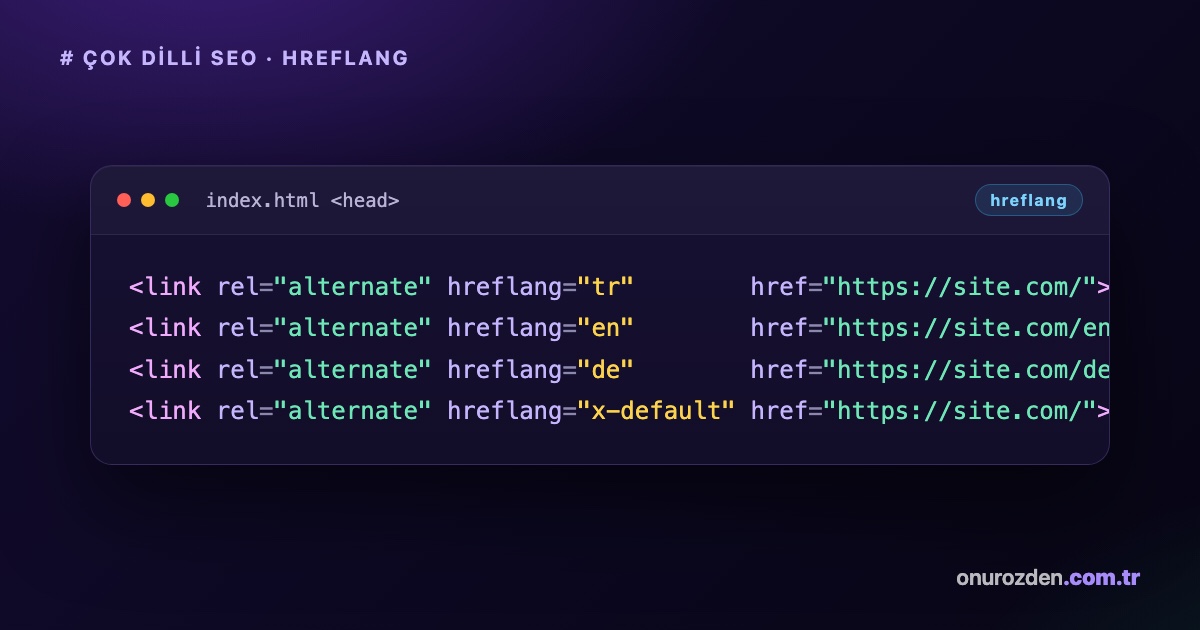
The hreflang code structure must be of a certain standard and placed in the head section of the web page so that search engine bots can easily read it. A separate line should be written for each language alternative and these lines must be in a self-referential structure. The following code example shows a standard hreflang tag structure containing Turkish, English and German languages and the x-default value:
<link rel="alternate" hreflang="tr" href="https://example.com/" />
<link rel="alternate" hreflang="en" href="https://example.com/en/" />
<link rel="alternate" hreflang="de" href="https://example.com/de/" />
<link rel="alternate" hreflang="x-default" href="https://example.com/" />
The first line indicates that the main language of the site is Turkish and that this address should be shown to users searching in Turkish. The second line tells search engines the URL address of the English-language alternative page. The third line defines the alternative page path prepared for German-speaking users. The x-default value in the last line indicates the default home page to which all users coming from languages other than the specified languages will be directed.
How to Add Hreflang Tags to the Site?
There are three different technical methods you can use to add hreflang tags to your website. Whichever method you choose, you need to remember that all pages must mutually approve each other. Here are these methods and application steps:
Adding to HTML Head Section
The most common method is to place the codes directly between the HTML head tags of each page. In this method, each page must list its alternatives one by one. For example, if your site has 3 different languages, there should be 3 hreflang lines in the source code of each page.
Using HTTP Header
In this method, which is especially preferred for PDF files or other non-HTML documents, hreflang information is added to the server response header. When the server sends the file to the browser or bot, it also transmits this language relationship information in the background.
Application with XML Sitemap
In order not to burden page codes on large websites, hreflang tags can be defined via the XML sitemap. Here are the steps you need to follow when applying this method:
- Create a separate loc element in the sitemap for each URL.
- Below each loc element, add all language alternatives for that page with the xhtml:link attribute.
- In each alternate line, specify both the language code and the full URL of the relevant page.
- Test the accuracy of the site map you prepared by sending it to Google Search Console.
To control how your site is crawled and indexed by search engines robots.txt & Sitemap Audit You can use our tool. Thanks to this tool, you can detect possible configuration errors in your sitemap in seconds.
What is the X-Default Value and When is It Used?
The x-default value is the default page definition that comes into play when the user's browser language setting or geographic location does not match any language defined on the site. This attribute is used to protect the user experience of sites that serve specifically on a global scale. For example, when a user from Spain enters an e-commerce site that does not offer a Spanish language option, the system redirects this user to the general English page set as x-default. In this way, the user reaches the international standard version of the site instead of encountering a blank or irrelevant page.
Below you can review the comparative table of ISO language and region codes that should be used according to different target audience scenarios:
| Target Audience and Region | Language Code (ISO 639-1) | Region Code (ISO 3166-1) | Correct Hreflang Usage |
|---|---|---|---|
| Turkish Users in Türkiye | en | TR | en-TR |
| German Users in Germany | also | ALSO | grandfather |
| German Users in Switzerland | also | CH | de-CH |
| General English Users | -most | Not Specified | -most |
What Are the Common Hreflang Errors in Multilingual SEO?
Technical errors during hreflang implementation in multilingual web projects confuse search engines and lead to indexing issues. Avoiding these errors is a critical step for your site's international SEO success. Here are the most common mistakes and their solutions:
- Lack of Reciprocal Confirmation: When page A points to page B, page B must also point back to page A. If this reciprocal link is not established, search engines will completely ignore the Google tags.
- Invalid Language or Region Codes: Only codes compliant with ISO standards should be used. For example, 'uk' is an invalid code for the UK; it should be 'GB'.
- Canonical Conflicts: The URL specified in the hreflang tag must match the canonical tag of that page. If you point to a different page as canonical instead of the page itself, the tags will be considered invalid.
To prevent such configuration errors, you need to regularly check your site's technical infrastructure. Indexability and Canonical Audit you can instantly analyze the indexing status of your pages and the accuracy of your canonical tags using our tool.
How to Audit Hreflang Tags?
To ensure your multilingual configuration is working flawlessly, you must perform regular technical analyses and test your code. A correct On-Page SEO audit prevents users from encountering the wrong language versions. During the audit process, you should first review the International Targeting report on Google Search Console to check for missing or incorrect tag warnings. Then, using crawling tools, you should analyze the reciprocal confirmation status and status codes of all pages to clean up hreflang tags containing broken links. This also allows you to use your site's crawl budget most efficiently.
Achieving a seamless user experience and high search engine visibility on multilingual websites depends on the complete implementation of technical SEO criteria. You can review our professional solutions to get ahead of your competitors in the international market and easily reach your target audience in their own language. You can contact us immediately for technical analyses tailored to your corporate projects and international growth strategies.
Does the hreflang tag directly affect ranking?
The hreflang tag is not a direct ranking factor, but it reduces bounce rate and indirectly improves your ranking by serving the right language version to the right users.
Can multiple hreflang tags be used on the same page?
Yes, if a page has multiple language or region alternatives, multiple hreflang tags can be used simultaneously, on a separate line for each alternative.
What is the difference between hreflang and canonical tags?
While the canonical tag selects a single unique version among duplicate pages, the hreflang tag is used to introduce alternative pages in different languages to search engines.
Is there case sensitivity in hreflang codes?
Language codes are generally written in lowercase letters, while region codes are written in uppercase letters, but search engines can usually understand lowercase region codes without any problems.
Which standard should be referenced for language codes?
The ISO 639-1 standard should be taken as a reference for language codes, and the ISO 3166-1 alpha-2 standard should be taken as a reference for regional codes if regional targeting will be made.