






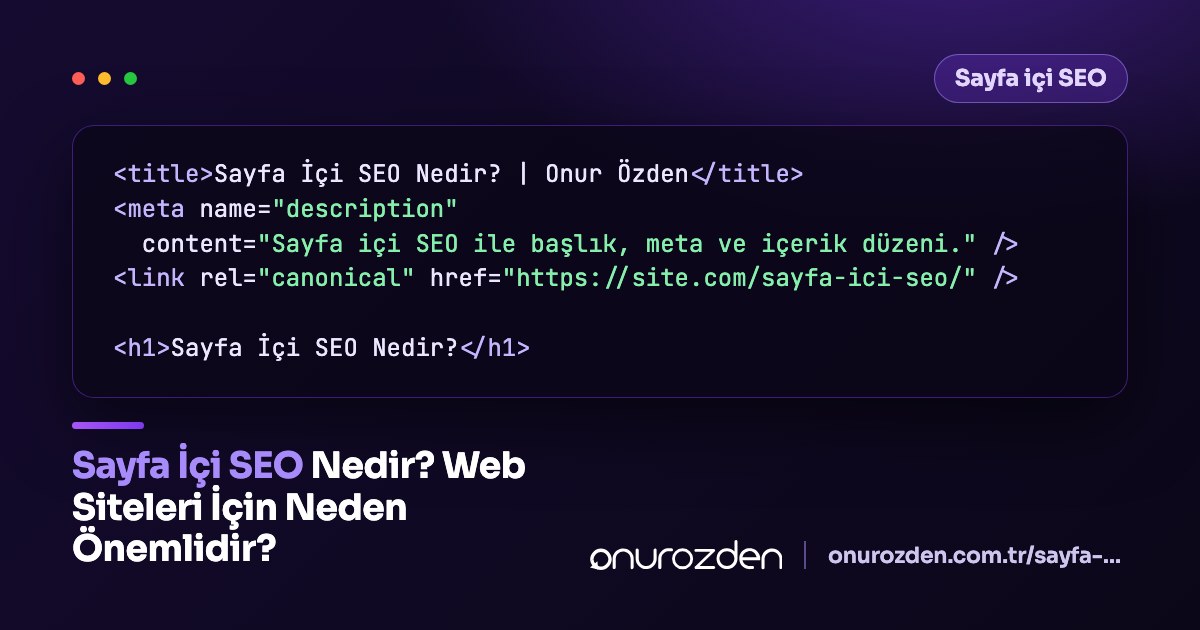
On-Page SEO, is the optimization of pages, content, and HTML code structure across a website to rank higher in search engines and attract organic traffic. These efforts, which help search engines better understand your website, focus directly on improving the user experience. A successful optimization process increases your website's visibility for your targeted search queries, allowing you to reach more potential customers.
What is On-Page SEO?
On-page SEO is the technical and structural optimization process that covers all components under your own control, from your website's code structure to content quality. When search engine bots crawl a page, they want to understand what the content is about, what questions it answers, and what kind of experience it offers to users. In this process, when on-page SEO techniques are applied correctly, search engines index your page more easily and match it with the right search queries. For example, let's take the website of a local dental clinic serving in Izmir. Instead of just sharing a general service list on the home page or service pages of this site, when a heading structure is established in accordance with on-page optimization rules such as 'Izmir Implant Treatment and Prices', search engines clearly grasp the purpose of the page. Thanks to this target-oriented work, users looking for implant treatment in the relevant region encounter this clinic's website directly, and a visible increase occurs in the site's organic traffic.
Why is On-Page SEO Important?
On-page SEO is the cornerstone of your digital presence because it ensures that search engines correctly interpret your web pages and that users stay on your site for longer. Without proper on-page SEO work, the reference links or advertising efforts your site receives from outside cannot show the efficiency they deserve. Understanding the contributions of on-page optimization to your site and how it differs from off-page efforts helps you manage your budget correctly. The differences between these two fundamental SEO disciplines are presented in detail in the comparison table below.
| Feature | On-Page SEO | Off-Page SEO |
|---|---|---|
| Focus Point | In-site content, code structure, and user experience | Backlinks, brand mentions, and social signals |
| Controllability | Completely under the site owner's control | Depends on the decisions of third-party sites |
| Basic Methods | Meta tags, content structure, and schema markup | Sponsored content and organic link building |
| Implementation Time | Easily editable and ready for immediate publication | Built over time through a natural process |
What Are the Most Effective On-Page SEO Techniques?
The most effective on-page SEO techniques are methods that help search engine bots easily decipher page hierarchy and aim to provide users with direct access to the information they are looking for. By applying these techniques to every page on your website, you can strengthen your position in search results. To achieve successful optimization, you should follow these steps in order:
- Optimize Title Tags: Each page should have only one H1 tag, and this title should reflect the main topic of the page. Subheadings should be organized in a logical hierarchy using H2, H3, and H4 tags.
- Keep URL Structure Simple: Instead of complex numbers or parameters, page addresses should consist of short, readable structures that include the target keyword.
- Add Image Alt Text: Search engine bots cannot read images directly, so short and clear descriptions defining the relevant image should be added to the alt text of every image.
- Create User-Focused Content: Your content should be prepared in-depth and uniquely, not just for search engines, but to answer users' questions in the most accurate way possible.
In addition to these steps, writing title tags that are the correct length and attention-grabbing directly affects your click-through rates. To learn more details while preparing your titles, you can benefit from our SEO-friendly title writing guide content.
How to Use Structured Data (Schema) in On-Page Optimization?
Structured data markup is a technical coding method that provides search engines with direct information about the meaning of the data on your page and allows you to obtain rich results in search results. Thanks to Schema codes, search engines instantly discover whether your page is an article, a product, or a local business. The JSON-LD code example below ensures that a web page is correctly interpreted as an article by search engines.
{
  "@context": "https://schema.org",
  "@type": "NewsArticle",
  "headline": "Sayfa İçi SEO Rehberi",
  "datePublished": "2026-03-30T09:00:00+03:00",
  "author": {
    "@type": "Person",
    "name": "Onur Özden"
  }
}
The first line of the code block above indicates that this data structure is presented in accordance with schema standards. The type definition in the second line informs the search engine that the page is news or article content. The title field in the third line defines the main heading that will appear in search results. The date and time information when the content was published is presented in the fourth line in a standard format. In the final lines, the fact that the author who produced the content is a real person and their name are transmitted directly to search engine bots.
Which Tools Should You Use When Optimizing Your Content?
During the on-page optimization process, you need to utilize auxiliary tools to regularly audit the technical status and tag accuracy of your pages. Thanks to the free tools on our website, you can detect technical errors in seconds. By using the Meta Tag Analysis tool on our site, you can easily check your pages' titles, descriptions, and other important tags. Simply enter the full address of the page you want to analyze into this tool. The tool checks the meta title and description lengths of your page, reports whether you comply with character limits, and shows you missing tags. This way, you can quickly identify faulty areas and instantly optimize your appearance in search engines.
What are the Common Mistakes Made in On-Page SEO Studies?
Mistakes made in on-page SEO work can cause your website to be penalized by search engines or lose ranking. Being aware of these errors and applying the right solutions protects the health of your site. Common mistakes and their correct solutions are as follows:
- Keyword Stuffing: Placing unnaturally frequent keywords in the content disrupts the user experience and is perceived as spam. Instead, you should use keywords with their natural and synonymous variants that fit the flow of the text.
- Duplicate Meta Tags: Using the same meta title and description on multiple pages on the site confuses search engines. You should create unique tags for each page that are completely unique and summarize the content of that page.
- Leaving Image Alt Texts Blank: Not writing alt text on images prevents search engines from indexing your images. For each image, you should write short alt texts that describe the content and include the target word without force.
Checklist for Successful On-Page SEO
This practical checklist, which you can use before launching each new page on your website or when updating your existing pages, allows you to make a complete optimization. You can improve the technical quality of your pages by checking the following items in order:
- Make sure only one H1 tag is used on the page.
- Meta Make sure that the title does not exceed 65 characters and the meta description does not exceed 160 characters.
- Optimize the size of all images on the page, compress them and add alt texts.
- Build internal links within the content that contain natural redirects to other relevant pages of your site.
- Test that the page displays quickly and smoothly on mobile devices.
After completing the on-page optimization steps completely, you can improve your site's overall search engine performance and manage a more professional process. monthly SEO You can review our packages and get expert support.
How long does it take for on-page SEO to show its effect?
The effect of optimizations usually appears within a period ranging from a few days to a few weeks, depending on the frequency with which search engine bots re-crawl your page.
Is on-page SEO enough to rank on its own?
While on-page optimization can be sufficient on its own in low-competition sectors, it needs to be supported by off-page efforts in highly competitive fields.
Is the Meta description a direct ranking factor?
The Meta description is not a direct ranking factor, but it contributes positively to your ranking indirectly by increasing the click-through rate of users to your site in search results.
Why are image alt texts important for on-page SEO?
Image alt texts allow search engine bots to understand the content of the image and help your page be listed in Google Image search results as well.