






We have now entered a period where the concept of GEO is frequently mentioned. As you know, every technology brings with it new concepts. GEO is one of them. GEO, “Generative engine optimisation” It is an abbreviation for the concept. Translated into Turkish in the most accurate way Productive Engine Optimization We can translate it as . Another common name AI Search SEO It is known as. The main purpose of GEO is not only for content to rank in search engines; To ensure that it is understood by productive artificial intelligence systems, taken as a reference and included in the answer production process.
Today, user behavior is changing radically. People don't just search anymore; he asks directly. Artificial intelligence systems, on the other hand, instead of providing classical connection lists synthesized, contextualized and summarized answers produces. In this new order, it is not enough for the contents to just be "sortable"; It also needs to be “quotable,” “summarizable,” and “understandable.” GEO meets exactly this need.
Why Did GEO Appear?
The search experience is changing from a link-clicking model to an answer-consuming model. This place is quite important. The user now wants to see a summary in a single productive answer instead of visiting 10 different sites and collecting information. This change also transforms content production strategies. The GEO approach aims to structure content according to the way artificial intelligence reads and interprets it. We can even say that it is advantageous during the expansion period due to the GEO structure. Because:
- The spread of artificial intelligence-supported search experiences
- Users gain the habit of asking questions directly
- Strengthening the response-oriented consumption model
- Increasing need for contextual accuracy and reliability of content
Difference Between GEO and SEO
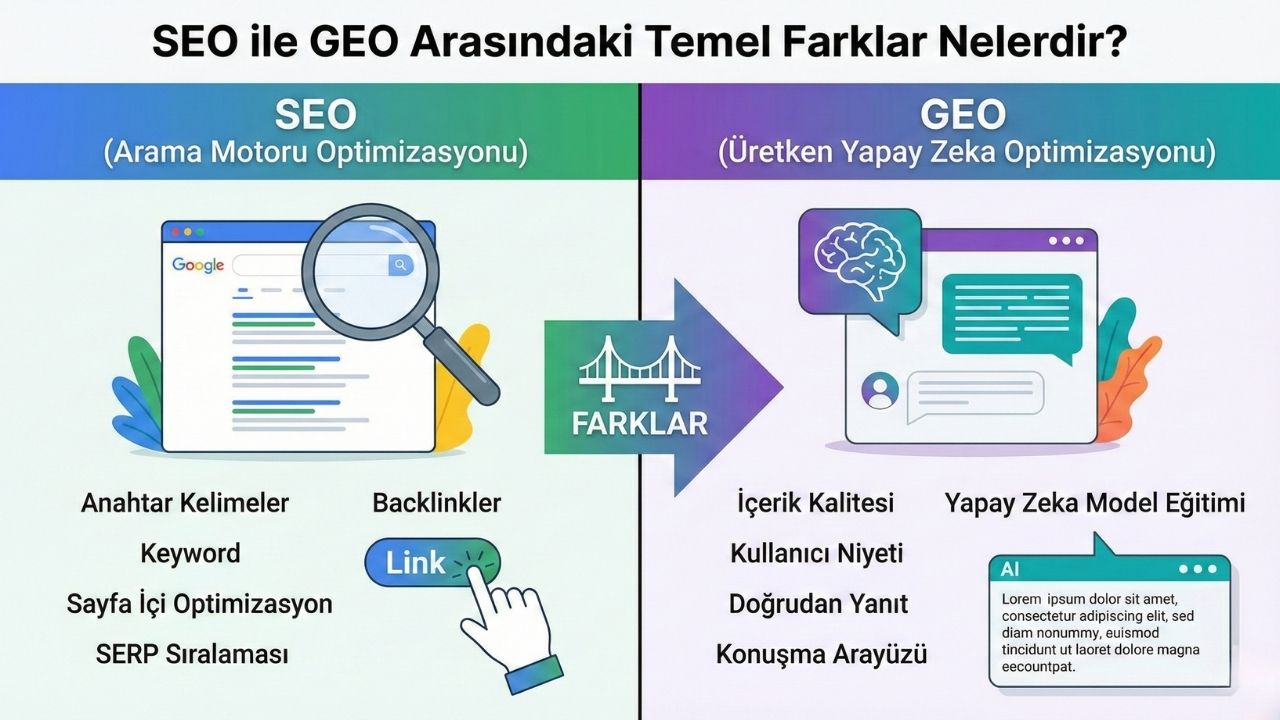
GEO is actually not an alternative to SEO but rather an evolution of it. Of course, there are significant differences between them in terms of target and visibility model. We have briefly summarized the difference between GEO and SEO in the following table:
| criterion | SEO | GEO |
|---|---|---|
| Main Purpose | Search engine ranking | Taking part in artificial intelligence answers |
| Visibility Area | SERP results list | Generated answer text |
| Content Approach | Keyword focused | Contextual and semantically focused |
| Success Measurement | click, sort | Don't be referenced, don't appear in the answer |
| Configuration | Technical + content optimization | Semantic integrity + reliability + data clarity |
This table actually shows that the two disciplines complement each other. GEO will not function properly without a strong SEO infrastructure. However, it seems impossible to be visible in productive artificial intelligence systems with only classical SEO.
How Does GEO Work?
GEO is a system with “understandability” at its core. Artificial intelligence systems content is not only at the word level; analyzes at the level of context, relationship and authority. Therefore, the following elements become critical in the GEO approach:
- Clear definitions and clear concept framework
- Semantic integrity and subject depth
- Reliable, verifiable information delivery
- Avoiding unnecessary repetition and superficial expression
- Structured and logical content flow
User experience plays a central role here. Because artificial intelligence systems are also optimized according to user satisfaction. Comprehensible, simple and clear contents are more valuable for both humans and machines.
Advantages of GEO to Businesses
GEO (Generative Engine Optimization) is a next-generation digital visibility approach that enables businesses to be visible not only in search engines but also in artificial intelligence-based response engines. Today, a significant portion of users have started to receive direct answers from ChatGPT, Gemini and similar platforms when searching for information. That's why digital visibility for businesses is no longer just about Google rankings. Thanks to GEO strategies, contents can be more easily understood, summarized and referenced as a reliable source by artificial intelligence systems.
Properly implemented GEO studies strengthen the digital authority of businesses and ensure that the brand appears more frequently on different platforms. Especially pages containing information-oriented content, definitions, data tables and question-answer formats are more easily analyzed by artificial intelligence systems. This helps businesses both obtain organic traffic and be seen as a more reliable source by potential customers. The main advantages that GEO strategies provide to businesses are:
- gain visibility in artificial intelligence search results
- Strengthening the brand's digital authority
- Increasing the likelihood of content being used as a reference source
- Diversifying organic traffic sources
- gain competitive advantage
- building long-term brand credibility
When traditional SEO and GEO strategies are implemented together, businesses can achieve much stronger digital visibility. While SEO strengthens search engine rankings, GEO ensures that content is referenced by artificial intelligence systems. The combination of these two approaches forms the basis for sustainable growth in modern digital marketing.
| Digital Visibility Zone | Traditional SEO | GEO Strategy |
|---|---|---|
| Google search results | strong | strong |
| AI response engines | limited | high visibility |
| Content reference | low | high |
| Brand authority | medium | strong |
Therefore, GEO strategies have become one of the fundamental approaches that provide a significant competitive advantage for businesses in the world of digital marketing, especially in 2026 and beyond.
Why Is GEO Focused on User Experience?
GEO's ultimate goal is not to manipulate algorithms. The aim is to provide the most accurate and clear information to the user in the shortest way. Artificial intelligence systems also work with this logic: they prefer reliable, consistent and contextual content. Texts that are complex, ambiguous, and rely solely on keyword repetition may be perceived as weak signals by productive systems. In contrast, clear title structures, clear descriptions, and text that directly answers user questions have stronger visibility potential.
The Future of GEO
Although GEO may seem like a new concept, it represents a permanent transformation when considering the direction of the search experience. As AI-powered search systems evolve, content will need to be not only findable but also meaningful. GEO is a user-centered, contextual and trust-based restructuring of digital content strategy. As the search world moves from a link list to an answer experience, GEO offers the foundational framework for staying visible in this new ecosystem.
Is Your Brand Ready for GEO?
GEO is no longer a theoretical concept, it is the new standard of digital visibility. Are your content architecture, semantic structure and authority signals read correctly by productive artificial intelligence systems? Onur Özden Web Çözümleri As we structure the transition process of brands from SEO to GEO with a data-based and sustainable strategy. For brands that want to be not only visible but also referenced in the age of artificial intelligence, the right start begins with the right analysis. If you want your brand to grow with the most up-to-date strategies without missing the latest technological developments, you can contact us.
WhatsApp to our line from here yazabilirsiniz.