






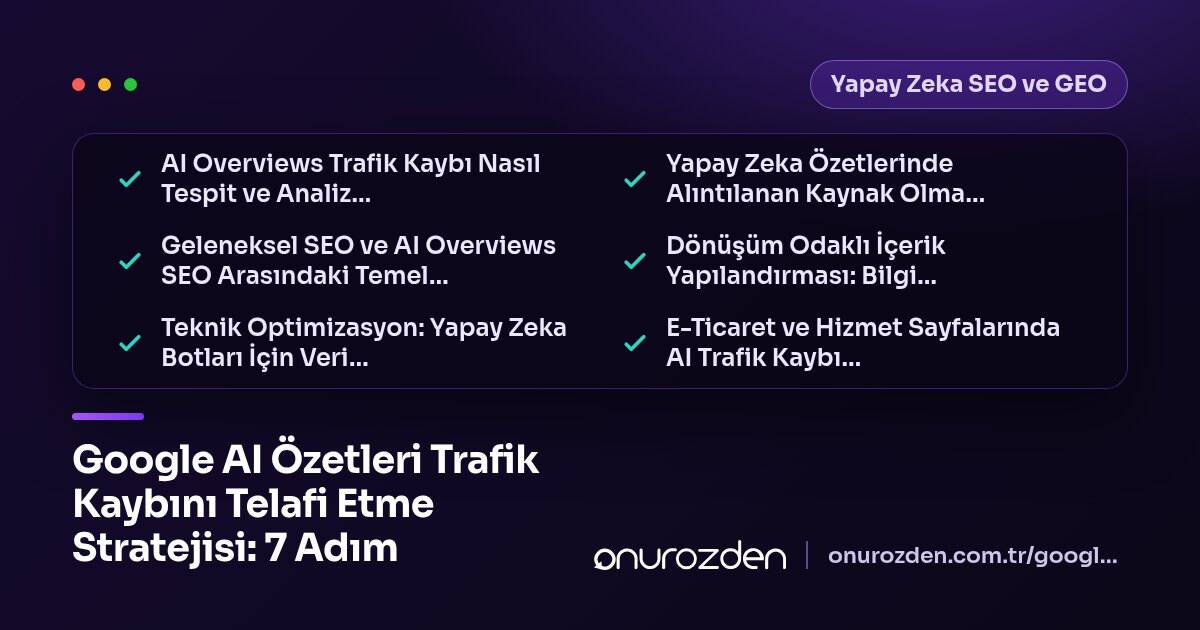
AI Overviews SEO, Google is the optimization process applied to reduce the negative impact of AI overviews at the top of search results on organic click-through rates and to make the brand a cited source. Traditional search engine optimization techniques are no longer sufficient on their own, and next-generation methods must be developed against the nature of AI panels that drive users away from the site.
How to Detect and Analyze AI Overviews Traffic Loss?
To analyze traffic loss caused by AI, it is necessary to segment and examine Google Search Console data correctly. Although Google does not yet offer clicks shown in AI overviews as a separate filter, sudden drops in CTR (click-through rate) for specific query groups are the primary indicator. First, a list of informational searches should be created, and the correlation between average position and clicks for these keywords should be examined. If clicks have decreased by 30% to 50% despite remaining in the top three, this is due to the AI panel presenting the result directly to the user. At this point, your brand's AI Citability Score should be measured to determine which pages need improvement. The steps to follow are:
- Enter the performance report on Google Search Console.
- Compare the last 3 months of data with the previous period.
- Filter for informational keywords with the highest drop in click-through rate.
- Manually search for these keywords on Google to check if an AI overview appears.
- Note whether competitors are cited in the AI panel.
For example, a SaaS platform receiving 15,000 organic clicks per month may see clicks drop to 8,500 despite remaining in the top spot for informational blog posts. To confirm that this drop is caused by AI panels, you should track the correlation between impressions and click-through rate on Search Console on a weekly basis. If the number of impressions remains constant while the CTR drops significantly, direct GEO optimization should be planned for the page.
Conditions for Becoming a Cited Source in AI Overviews
Google Being a source in AI panels depends on the content's capacity to provide structured and verifiable information. AI engines prefer paragraphs containing clear answers rather than complex sentences. It is recommended to apply the following checklist to increase the likelihood of your content being cited:
- The first sentence under each subheading should be a direct answer to the question asked in the heading.
- Answer paragraphs should be kept between 40-60 words to provide a format that the model can easily cite.
- Data and statistics should be up-to-date and, if possible, based on original research.
- The page should include a frequently asked questions section related to the topic.
- Schema markup structures appropriate for the service or article type must be fully implemented.
- Definitions, lists, and short tables should be presented together within the content.
The most critical factor increasing citation success is information architecture. AI bots skip vague descriptions when crawling content. Clearly defining terms in the upper sections of your page makes it easier for bots to choose your text as the primary source of definition. Additionally, having bulleted lists follow a logical order strengthens the likelihood of the model referencing your site when generating summaries.
Key Differences Between Traditional SEO and AI Overviews SEO
While traditional SEO methods focus on attracting the user to the site with a specific keyword, in the world of AI Overviews, the focus is on summarizing the topic comprehensively and providing the most reliable data set to the bots. The differences between these two approaches play a critical role in determining your strategy.
| criterion | Traditional SEO | AI Overviews (GEO) SEO |
|---|---|---|
| Target Unit | Keyword Focus | Topic Integrity and Context |
| Content Structure | Long and Detailed Blocks | Modular and Answer-Oriented Sections |
| CTR Expectation | High (Top 3 Positions) | Low (Zero-Click Pressure) |
| Bot Behavior | Indexing and Ranking | Data Synthesis and Citation |
While ranking position is the fundamental success metric in traditional SEO, positioning yourself as an information source in AI search engines takes precedence. Search engines now attempt to resolve user search intent directly on the results page. Therefore, you must build your strategy not only on ranking but also on earning reference links within AI answer cards.
Conversion-Oriented Content Structuring: Closing the Information Gap
Producing content with a depth that AI cannot answer is the primary method to ensure users click through to your site even after reading the summary. AI generally provides generic and superficial information; expert opinions, local details, and downloadable resources increase the user's motivation to visit the site. For example, instead of competing with the standard divorce petition template provided by AI for the keyword 'divorce petition,' a law firm can enrich its page with a table of current district-based courthouse fees and lawyer-approved downloadable PDF drafts. In this scenario, even if the user gets the general information from AI, they will visit the law firm's site with a 15% higher click-through rate to perform the concrete action. For this pursuit of depth, Google Gemini SEO guide current methods within should also be examined.
To ensure the user stays on the site, you must integrate the following content components into every guide:
- Topic-specific downloadable templates, checklists, or calculation tables.
- Mini-scenarios and solutions based on real case experiences.
- Local regulations, regional pricing, or practical application nuances that AI cannot foresee.
Technical Optimization: Data Preparation for AI Bots
Technical configuration is essential for search engine bots to better interpret content and mark your site as a reliable source when training AI models. Specifically, structured data helps bots verify claims and data in the text. You need to determine which data will be accessible to bots by llms.txt and AI Access Audit on your site. The JSON-LD code example below is used to indicate a content's suitability for voice searches and AI answers:
{
  "@context": "https://schema.org",
  "@type": "WebPage",
  "speakable": {
    "@type": "SpeakableSpecification",
    "xpath": [
      "/html/head/title",
      "/html/body/p[1]"
    ]
  }
}
The first line of the code above defines the standard context of the schema. The second line specifies that the page is a webpage. The 'speakable' section activates the content's voice readability. The XPath lines inform the search engine that the page title and the first paragraph can be used as a summary.
On the technical side, your HTML structure must be clean for bots to quickly crawl and parse the data. Unnecessary JavaScript loads, tags that increase DOM depth, or hidden text blocks make it difficult for bots to access information. Embedding structured data directly into the source code and performing regular checks with Google Testing Tools eliminates potential obstacles on the technical side.
AI Traffic Loss Compensation for E-Commerce and Service Pages
E-commerce sites and local service businesses are experiencing significant visibility loss as AI begins to provide product recommendations. To compensate for this loss, it is necessary to include user experience data and real customer reviews in structured data. Instead of just listing the services provided, a beauty salon embedding short videos explaining the pre- and post-application process without compromising page speed creates visual evidence that AI cannot offer. Within the scope of professional artificial intelligence seo strategies, using interactive calculation tools or comparison wizards that keep the user on the site on commercial pages minimizes click loss.
E-commerce platforms should add technical specification tables, pros and cons lists based on real user experiences, and usage scenario sections directly to product pages. Even if AI provides a general product summary, the user will visit your site to verify critical details such as shipping process, box contents, and warranty coverage. Therefore, you must transform your pages from catalogs into interactive guides.
Common Mistakes in AI SEO Process
Mistakes made while building a strategy can cause existing organic traffic to erode faster. Common mistakes and their corrections are as follows:
- Mistake: Having all content written by AI and publishing it without review. Correction: Drafts should be created with AI, but expert opinions and unique data must be added manually.
- Mistake: Keeping structured data (schema) limited only to the article type. Correction: FAQ, Product, Service, and Speakable schemas must be used together.
- Mistake: Focusing only on short answers and neglecting depth. Correction: Long-form content that keeps the user on the site by asking 'why' and 'how' questions must be maintained.
- Mistake: Blocking all bots completely with llms.txt and robots.txt files. Correction: Controlled access should be given to bots, leaving only the pages intended for citation open.
Protecting Brand Authority in the Future Search World
As search engines become AI search engines in the future, the way to protect brand authority is to be mentioned not only on Google but across all large language models. For this, you must manage your digital assets like a data source. Increasing social signals, presenting industry-related technical documents as PDFs, and obtaining natural backlinks from authoritative sites ensure that AI perceives your brand as a reliable authority. For long-term success, you should periodically update your content and revise your response formats by following changes in AI panels. Gaining visibility in AI engines is a combination of technical preparation and quality content structure. Brands that correctly implement strategic steps will succeed in maintaining their traffic in this new era. AI SEO packages you can get support from our expert team for.
Google Do AI Overviews cause traffic loss?
Yes, because AI overviews provide the answer to a query directly on the results page, they can reduce click-through rates by 30% to 50% for informational searches.
Does appearing as a source in AI overviews increase the number of clicks?
Being among the cited sources increases brand authority, but it does not guarantee a click-through rate as high as traditional SEO on its own; it must be supported by in-depth content.
Which sectors are more affected by AI Overviews updates?
Sectors where users seek quick information or product recommendations, such as healthcare, law, finance, and e-commerce, are the areas most affected by these updates.
Should I use a specific tool for AI Overviews SEO?
Professional analysis tools that track search results and measure AI citability scores provide a significant advantage in determining your strategy.
Should I block AI bots from crawling my site?
It is generally not recommended, as blocking bots prevents you from being cited in AI answers and appearing in the future search ecosystem.