






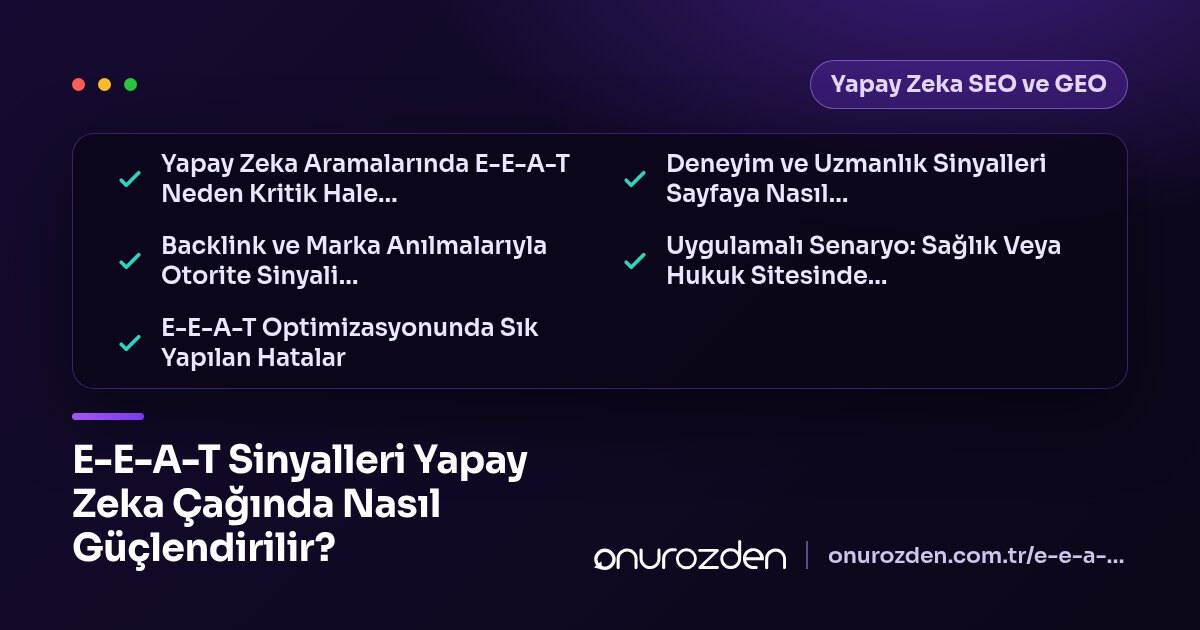
E-E-A-T; It is the core trust system consisting of Experience, Expertise, Authoritativeness, and Trustworthiness criteria, used by AI search engines and Google to verify the source of content. In today's world, where the amount of AI-generated content is rapidly increasing, search engines focus more than ever on these four pillars to understand which information is accurate and reliable. A website's ranking no longer depends solely on keyword placement, but on the digital reputation of the person and organization producing that content.
Why Has E-E-A-T Become Critical in AI Searches?
AI search engines prioritize verified and authoritative sources to minimize the risk of hallucination when providing answers to users. Platforms like ChatGPT, Gemini, and Perplexity do not just look at the linguistic structure of the text when processing complex data; they also check whether the signature behind the information is based on real experience. For example, an article containing investment advice might be flagged as risky by AI when shared by an anonymous user, whereas it is cited as a reliable source when it comes from the profile of a certified financial analyst.
To strengthen E-E-A-T signals, the following 5 key areas must be optimized:
- The author profile must be consistent and verifiable across all digital platforms.
- Providing evidence of "first-hand experience" (personal observations, test results, case studies) in content.
- Transparent sharing of corporate contact, address, and legal imprint information.
- Regular production of niche and technical content that supports topical authority.
- Increasing natural references (backlinks) from industry authority sites.
In this process, it is essential that your website's technical infrastructure also supports this trust. Guide to appearing in ChatGPT responses As we mentioned in, bots tend to identify your brand as an expert when they find data in a structured format.
How to Reflect Experience and Expertise Signals on the Page?
The most effective way to reflect experience and expertise signals on the page is to assign an expert author based on the content's topic and prove this author's competence with both text and visual elements. Instead of just providing theoretical information, adding screenshots showing the subject being applied, real-world scenarios, and personal commentary allows you to meet the "Experience" criterion of AI bots. On the expertise side, the author's academic background, professional certifications, and other previously published articles in that field should be highlighted.
You can use the following checklist when optimizing your content:
- Is it clearly stated at the beginning of the article who the author is and why they are an expert on this subject?
- Does the content mention personal experiences or original test results regarding the topic?
- Are the links (citations) to external sources from reliable and official institutions?
- Are there links to the author's social media profiles such as LinkedIn and Twitter?
- Is the data used in the content supported by up-to-date sources?
How to Define Author and Brand Authority with Structured Data (Schema)?
Structured data markup is the most definitive way to explain information about a page to search engine bots in a technical language they can understand. Schemas in JSON-LD format placed within HTML codes clarify that the author is a human (Person) and the brand's (Organization) industry position. This way, Google and AI tools access identity information directly at the code level instead of guessing who wrote the content.
{
  "@context": "https://schema.org",
  "@type": "NewsArticle",
  "author": {
    "@type": "Person",
    "name": "Onur Özden",
    "url": "https://www.onurozden.com.tr/yazar/onur-ozden/",
    "jobTitle": "SEO Stratejisti"
  },
  "publisher": {
    "@type": "Organization",
    "name": "Onur Özden Web Çözümleri",
    "logo": {
      "@type": "ImageObject",
      "url": "https://www.onurozden.com.tr/logo.png"
    }
  }
}
In the code block above, the first line defines schema.org standards. The second line indicates that the content is a news item or an article. The Author object hierarchically presents the author's name, profile page, and professional title. The Publisher section informs bots about the institution where the content is published and the brand's logo. To verify that these markups on your site are error-free, Structured Data Audit tool can be used. When you query your URL with this tool, you can instantly see whether the author and organization schemas on the page are read correctly by Google, the list of missing fields, and suggestions for corrections.
Creating Authority Signals with Backlinks and Brand Mentions
The authoritativeness signal is more about what the rest of the internet says about you than what your website says about itself. Links from reputable sites related to your industry and mentions of your brand name (even without a link) in reliable sources directly increase your E-E-A-T score. AI models create an authority score by analyzing which brands are mentioned more frequently and positively on specific topics while scanning large datasets.
| Evaluation Criteria | Traditional SEO Perspective | AI (GEO) Perspective |
|---|---|---|
| Link Source | Every site with a high DR/DA value. | Authority with high sectoral relevance. |
| Mention Style | Only clickable links. | Brand name and author expertise attribution. |
| Anchor Text | Keyword-focused texts. | Natural, descriptive, and brand-oriented texts. |
| Context | Random position of the link on the page. | In-paragraph link that ensures topical integrity. |
When measuring the quality of these signals coming from the outside world, quality backlink criteria must be taken into consideration. The AI era has made references that bring real traffic and come from niche sites much more valuable than quantity-focused link building.
Applied Scenario: E-E-A-T Transformation on a Health or Law Site
Sites in YMYL (Your Money or Your Life) categories, such as law and health, are the platforms that must adhere most strictly to E-E-A-T criteria. For example, when lawyer biographies with bar registration numbers, legal article references, and Person schema are added to articles on a law portal with 5,000 monthly organic visitors, the results change dramatically. In one implementation, it was observed that after these technical touches, the site's citation rate in AI responses increased by 45%, and it was cited as a direct source for queries like 'How to file an X lawsuit?'.
The transformation process is carried out with the following steps:
- All existing content is scanned to identify unsigned or anonymous articles.
- Each piece of content is reviewed by a professional expert in the field (lawyer, doctor, engineer) and a 'Medical/Legal review performed' statement is added.
- The last update dates of the content and their compliance with legislative changes are checked.
- Physical office address, phone number, and business registration documents are added to the contact page.
- Service and team pages are restructured with transparent language.
Common Mistakes in E-E-A-T Optimization
Many businesses resort to wrong methods, thinking they can deceive AI tools. However, modern algorithms can quickly detect inconsistencies and mark the site as untrustworthy.
- Creating fake author profiles: Creating authors with stock photos and fabricated biographies is easily detected when bots perform profile photo and social media matching. Use real team members instead.
- Sharing statistics without sources: Not specifying the source of numerical data used in the text damages trust. Add an official source link next to every important piece of data.
- Leaving contact information incomplete: Sites that only have a contact form are considered anonymous. Share a clear address and verified phone information.
- Presenting outdated content as new: Just changing the date of old content without updating the content itself is misleading to both the user and the algorithm. Truly revise the content.
E-E-A-T signals are your website's certificate of honesty and professionalism in the digital world. Brands that correctly structure these signals achieve lasting success in both Google and new-generation AI search engines. To manage your strategy with a professional team, AI SEO packages you can get support via.
Is E-E-A-T a direct ranking factor?
Google has stated that E-E-A-T is not a direct technical ranking factor, but the algorithm uses these signals to determine quality.
How do AI tools detect E-E-A-T signals?
Bots create a trust score by analyzing the author's other writings on the web, digital reviews about the brand, and the page's technical schema codes.
Is adding an author bio enough for E-E-A-T?
A bio alone is not enough; the author's expertise being confirmed by external sources, certifications, and the freshness of the content are also evaluated simultaneously.
How can small businesses improve their E-E-A-T score?
They can gain authority by writing in-depth guides in their niche, collecting customer reviews, and appearing by brand name in industry directories.