






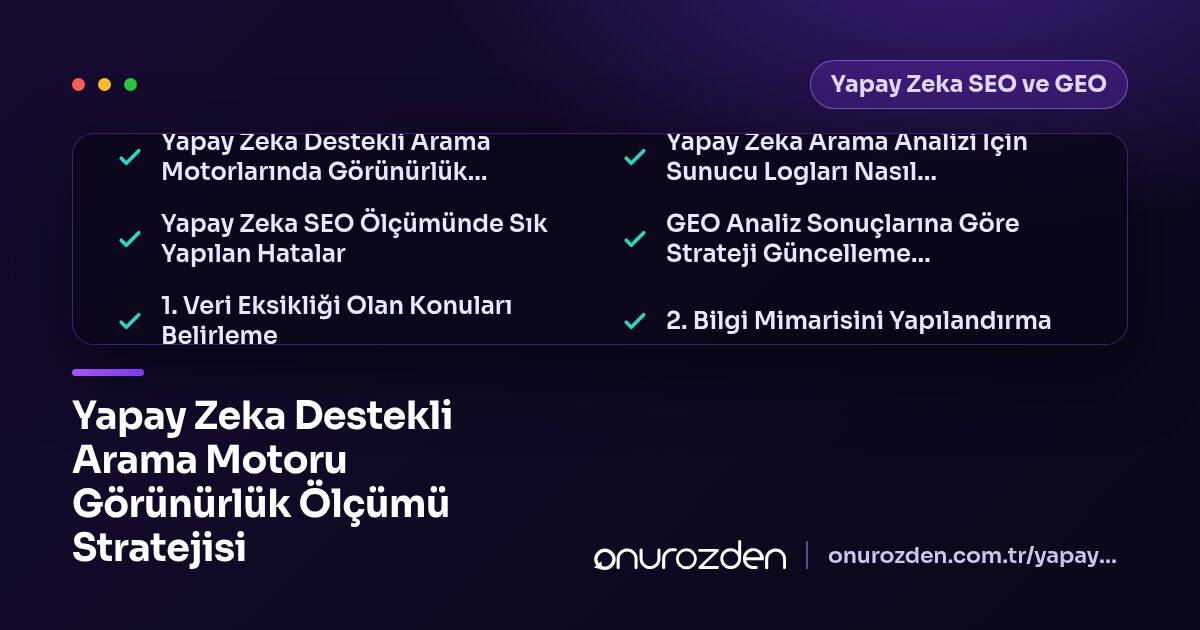
Choosing a artificial intelligence powered search engine Measuring visibility via is the process of regularly monitoring your brand's citation rate and citing share in response engines. While ranking tracking is position-based in traditional search engines, in-text citation and brand mention rates are critical in artificial intelligence systems. For businesses to be successful in the field of artificial intelligence SEO, they need to monitor these new measurement dynamics with the right analytical methods.
How to Measure Visibility in Artificial Intelligence-Powered Search Engines?
Visibility measurement in artificial intelligence search engines is determined by the frequency of your website being included as a link in the structured answers produced by the systems. While traditional SERP tracking measures where you rank for a particular keyword, in artificial intelligence models you directly verify whether you have been selected as an information source. The differences between the two approaches arise from the operating logic of the systems.
| Measurement Criteria | Traditional SEO | AI SEO (GEO) |
|---|---|---|
| Basic Metric | Ranking Position (1-10) | Citation Rate |
| Content Indexing | HTML and Connection Structure | Subject Integrity and Entity Relationships |
| Traffic Generation | Direct Search Click | Referral and Referral Links |
| Browser Type | Googlebot, Bingbot | GPTBot, PerplexityBot, ClaudeBot |
To start the measurement process, you must first identify basic query patterns related to your industry. You then need to record how often your brand is cited when these queries are run in response engines. To understand this analysis in a broader perspective Difference between GEO and classic SEO You can review our comprehensive guide about.
GEO Metrics: How to Analyze the Performance of ChatGPT and Perplexity
Text mining and source tracking methods are used to measure the performance of GEO on platforms such as ChatGPT and Perplexity. While artificial intelligence systems produce information, they link to sites they consider authoritative. We can list the basic metrics you should consider when analyzing your performance as follows:
- Citation Rate: It is the percentage of your site appearing as a footnote or link in target queries.
- Brand Mention Frequency: It is the rate at which your brand is mentioned as a name in the text, even if a link is not given.
- Source Position Order: It is the order in which you are referenced in the response text.
- Information Accuracy: It is the up-to-dateness of the information provided by artificial intelligence about your brand.
- Scanning Frequency: It is the number of regular visits made by artificial intelligence bots to your site.
Let's take a digital marketing agency for example. If the site receives in-response links 35 times in 100 different requests asked in the digital marketing category, the citation rate is calculated as 35%. To increase this data, it is necessary to know how systems make sense of the content. During analysis, you should consider that each platform (Perplexity, Gemini, ChatGPT) may have different resource preferences.
How Should Server Logs Be Examined for Artificial Intelligence Search Analysis?
Server log files are the most accurate way to verify how frequently AI crawlers visit your site. Artificial intelligence search engines use special user agents to collect information. You can create custom log definitions in your server configuration to monitor these accesses. In particular, sudden drops in crawl frequency may indicate content quality or technical access problems.
The following Nginx log format and filtering command allows you to isolate GPTBot accesses at the server level:
log_format ai_bots '$remote_addr - $remote_user [$time_local] "$request" $status $body_bytes_sent "$http_referer" "$http_user_agent"';
grep -E "GPTBot|PerplexityBot|ClaudeBot" /var/log/nginx/access.log > ai_access.log
The first line in the code example defines a special log structure that will record user agent information of requests coming to the server. The second line extracts the artificial intelligence bots from the access records with a command running on the terminal and transfers them to a separate file. The purpose of each row is to optimize the crawl budget by separating bot traffic from general traffic. Thanks to this process, you can clearly see which of your contents are scanned by artificial intelligence more frequently.
To check how easily your site is read by bots, llms.txt control You can use the tool. When you enter your domain name into the tool, you can see in a few seconds whether your browsing permissions and artificial intelligence routing files are complete.
Sectoral Sample Scenario: Quotation Share Calculation of an E-Commerce Site
500 product-focused search requests were simulated to measure the performance of an e-commerce site with 50,000 monthly organic visitors in artificial intelligence search engines. While the brand's citation rate was initially measured at 12% in ChatGPT and Gemini responses, this data increased to 34% after the content structure and information architecture were updated. This increase occurred as a result of product descriptions being supported with clearer and technical data.
| Measurement Period | Simulated Query | Number of Quotations | Citation Rate | AI Sourced Traffic |
|---|---|---|---|---|
| Month 1 (Beginning) | 500 | 60 | %12 | 450 Visits |
| Month 3 (Optimization) | 500 | 115 | %23 | 1,200 Visits |
| Month 6 (Result) | 500 | 170 | %34 | 2,850 Visits |
In this scenario, increasing the citation rate from 12% to 34% resulted in an approximately 6x increase in referral traffic. Free to find out the current citable capacity of your site AI Citability Score You can query by typing your domain name into our tool. The tool provides a numerical score for the likelihood of your content being cited by artificial intelligence engines. If your score is low, you may want to consider making your content more direct and data-driven.
Common Mistakes in Measurement of Artificial Intelligence SEO
To get accurate data on AI search metrics, you need to avoid common analysis mistakes. Common mistakes and corrections to be made are:
- Relying Only on Classic SEO Tools: Artificial intelligence engines do not work based on classic keyword ranking. Fix: Use analytic methods that track in-response citations.
- Forgetting That You Blocked Bot Access: Preventing AI bots from scanning the robots.txt file will spoof the measurement data. Fix: Check the allowed bot list regularly.
- Not Separating Brand Mentions from Links: Mentioning a name in the text and providing a clickable source does not have the same effect. Fix: Keep the two data separate in your reports.
- Making a Decision in a Single Query: AI responses are probabilistic and may change with each prompt. Fix: Find the average value by simulating the same query at least 5 times at different times.
GEO Strategy Update Steps According to Analysis Results
You can follow these steps to turn the resulting measurement data into action and make visibility permanent in artificial intelligence engines:
1. Identifying Topics with Missing Data
List the target queries for which your citation rate is 0% and determine which competitor sources the answer engines are using for these questions. For example, if you are a law firm and your competitors get quotes for the query "rent increase rates" but you do not, you should review the data accuracy and technical configuration on that page. It is helpful to examine what table structures or bullet lists competitors are using.
2. Configuring the Information Architecture
Include summary paragraphs and technical data that directly respond to your pages. Artificial intelligence models reference clear definitions and structured data (JSON-LD) more easily, rather than complex narratives. Especially "What is it?" and “How to do it?” Include clear definitions of at most 3 sentences in the sections.
3. Establishing Authoritarian Source Collaborations
Make sure your brand is included in the training sets of artificial intelligence models and powerful news sites in the data pool. External source references and backlinks from authoritative sites directly increase the likelihood that artificial intelligence will select you as a reliable source. At this point, promotional writing works are an element that reinforces brand authority.
4. Keeping Content Up to Date
Artificial intelligence systems generally tend to provide the most up-to-date data. Enrich your old content with new data, current statistics and fresh information. In particular, updating pages containing legislation, prices or technical guides every 3-6 months protects the possibility of citation.
5. Regular Performance Screening
Recalculate quote rates on a monthly basis. Focus on staying in the systems' up-to-date data pool by refreshing outdated information on pages that show decreased performance. Analyze trends by tracking data changes on Excel or a dashboard.
Professional technology to increase your brand's citation share in artificial intelligence search engines and establish a sustainable strategy AI SEO You can review our solutions.
Can ranking tracking in artificial intelligence search engines be done with classic SEO tools?
While classical SEO tools measure fixed sequence numbers, AI engines produce dynamic responses. For this reason, GEO focused methods that track citation rates should be used.
How often should the ChatGPT citation rate metric be checked?
It is recommended to check the citation rates monthly, taking into account the data update speed and search habits of the models.
Can I see from Google Analytics that AI crawlers are crawling my site?
No, Google Analytics only registers browsers running JavaScript. To see bots like GPTBot, you need to review the server logs.
Does taking part in AI answers increase organic traffic?
Citing AI answers provides qualified referral traffic with a high conversion rate and strengthens brand authority.